Author: Mike Manges
Key Highlights:
- Retail tire prices have remained surprisingly stable despite inflationary pressures, with variations across different tiers.
- Manufacturers have announced moderate price increases, mainly between 1% and 4%, focusing on specific segments like commercial truck tires.
- The Iran conflict has had a limited direct impact on retail tire pricing, but ongoing energy and logistics costs could influence future prices.
MTD: What’s the state of consumer tire pricing at the retail level?
Brooks: Retail tire prices have remained surprisingly resilient through the first half of 2026, yet the market’s stability continues to rest on an uncertain foundation and we feel there is some strain and caution ahead. Despite the ongoing pressure from rising raw material costs, increased transportation expenses, tariffs and broader inflationary trends, consumer tire prices have remained relatively stable compared to what we may have anticipated at the beginning of the year.
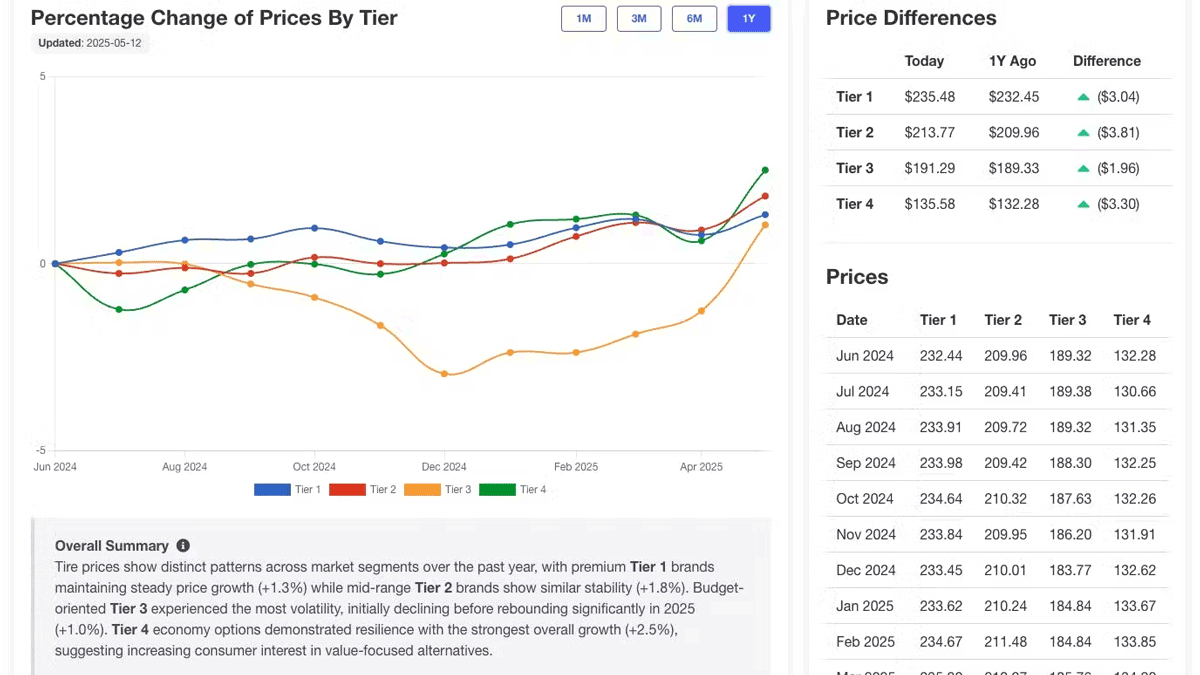
Through the first six months of 2026, pricing trends have varied by tier. Premium (tire-one) and lower-tier (tier-four) brands have generally experienced modest price increases, while many mid-tier (tier-two and tier-three) brands have remained relatively flat with some slight rolling decreases. Retailers continue to balance the need to protect margins with maintaining competitive pricing in an environment where consumers remain highly price-sensitive.
The competitive landscape and current economic conditions have limited the industry’s ability to fully pass through higher costs. As a result, pricing discipline and analysis have become increasingly important, with retailers leveraging more sophisticated pricing analytics to make market-specific decisions. Choosing between maintaining healthy margins and moving units has become more of an art than a science.
MTD: Have you seen tire manufacturers enact price increases over the past few months and if so, were they bigger, smaller or flat in relation to past first-half price hikes?
Brooks: Multiple tire manufacturers announced price increases during the first half of 2026. Most increases have ranged between 1% and 4%, though some manufacturers have announced increases of up to 8% in select categories and product lines. Compared with historical first-half pricing actions, these increases have generally been moderate and more targeted than broad. Many manufacturers have focused increases on specific segments, including commercial truck tires, while passenger and light truck tire categories have also seen selective pricing actions.
The primary drivers cited by manufacturers include rising raw material costs, higher freight and shipping expenses, increased labor costs, tariff-related impacts and broader inflationary pressures affecting overall operating expenses. It’s also important to note that not all announced price increases have fully taken effect. Some have already been implemented, while others are scheduled to roll out throughout the remainder of 2026.
MTD: How much of an impact has the war in Iran had on retail tire pricing?
Brooks: At this point, I believe we are still in the early innings of understanding the full downstream impact. To date, the conflict involving Iran and the greater Gulf region has had only a modest direct effect on retail tire pricing. One reason is that many manufacturers, distributors and retailers entered 2026 with inventory that was purchased prior to current world events. That inventory has provided a temporary buffer against immediate cost increases.
However, the conflict has contributed to broader uncertainty surrounding global energy markets, transportation costs and inflation. If elevated oil prices and shipping disruptions persist, those cost pressures will eventually work their way through the supply chain. While we have not yet seen widespread retail tire price acceleration directly tied to the conflict, the industry is closely monitoring developments because energy and logistics costs are significant inputs into tire manufacturing and distribution.
MTD: How are the tire retailers you talk with reacting to price increases?
Brooks: Overall, retailers have remained resilient, but they are approaching pricing decisions with a high degree of caution. With retail sellout trends softening in some markets and consumers continuing to feel the effects of inflation, retailers are extremely sensitive to any pricing action that could impact demand.
Many consumers remain value-focused and continue to trade down to more affordable brands and tiers. Higher fuel costs and ongoing inflationary pressures have further increased price sensitivity among consumers. As a result, retailers are relying more heavily on pricing intelligence and market-level analytics than ever before. They are evaluating pricing at a much more granular level by market, brand, tier, size, tread pattern and seasonality to identify opportunities to remain competitive while protecting profitability.
The most successful retailers are taking a strategic approach, selectively investing in key products to drive volume while preserving margins in categories where demand and competitive dynamics allow. In today’s environment, pricing is no longer a one-size-fits-all exercise. It requires constant monitoring and a market-specific strategy.
MTD: What do you expect to see on the retail tire pricing front during the second half of 2026?
Brooks: Looking ahead, we expect retail tire prices to trend modestly high through the remainder of 2026. However, we do not anticipate the type of immediate or dramatic pricing reactions that occurred following the tariff announcements in April 2025. Instead, we expect a more measured pricing environment characterized by incremental manufacturer increases, selective category adjustments and continued competitive pressure at retail. Consumer demand remains relatively cautious, which will likely limit how aggressively retailers can pass along higher costs. That said, several factors could influence pricing during the second half of the year, including additional tariff actions, sustained increases in raw material costs, changes in energy prices and geopolitical developments. If these pressures persist, retailers and manufacturers may have little choice but to continue implementing targeted price increases. Overall, barring major market disruption, the second half of 2026 is likely to be defined by gradual pricing pressure, rather than sharp industry-wide increases.
Article originally published by Modern Tire Dealer.